
Gundog group
Ireland
Irish Setter
Beautiful, boisterous and endlessly good-natured, the Irish Setter is a joy for active people and a hurricane for everyone else.
Reviewed by the SniffScroll editorial team
The redhead with the endless puppyhood
The short version
- A high-energy gundog needing at least ninety minutes of proper daily exercise, ideally with off-lead running.
- Wonderful with children and strangers alike; boisterousness, not aggression, is the management issue.
- Matures slowly: expect puppy brain in an adult body until age two or three.
- The feathered mahogany coat needs brushing two or three times a week to stay mat-free.
- Deep-chested and at real risk of bloat; every owner should know the signs and prevention.
- Weight
- 24 to 32 kg
- Height
- 58 to 67 cm
- Lifespan
- 12 to 15 yrs
- Size
- Large
- Group
- Gundog
- Coat
- Silky feathered
- Grown male
- 27 to 32 kg
- Grown female
- 24 to 29 kg
- Years to full size
- about 2
- One-off setup
- €500 to 1100

Get one if…
- Active families and outdoorsy people who walk or run daily
- Households with children who want a playful, patient companion
- Owners with secure space for off-lead running
- People who enjoy training a clever, clownish dog with humour
- Multi-dog households; the breed is usually sociable and easy
Think again if…
- Anyone wanting a calm, low-energy or low-maintenance dog
- Owners who cannot offer ninety minutes of daily exercise
- House-proud minimalists; the coat sheds and carries mud
- People needing a reliable guard dog
- Anyone without patience for a two-year puppyhood
Trait profile
Pure enthusiasm in a beautiful coat: affectionate with everyone, tireless outdoors, and slow to grow up.
Space & setup. Needs space: a large, high-energy gundog that struggles in small flats unless exercise is truly generous every single day.
Allergies. Not hypoallergenic. The silky coat sheds moderately year-round and the feathering collects burrs, mud and whatever the garden offers.
Living with a Irish Setter
A gloriously handsome gundog with a mahogany coat, boundless enthusiasm and a joyful, scatty charm that outlasts most owners' patience and wins them over anyway.
If dog breeds had personalities at a party, the Irish Setter would be the one greeting every guest at the door, knocking over a drink with its tail and somehow getting away with it because it is just so delighted to see you. This is a breed of genuine, unrestrained joy, and living with one is a daily lesson in not taking life too seriously.
The breed was developed in Ireland as a working gundog, ranging widely over rough ground to find and point game birds. That heritage explains everything about the modern Irish Setter: the stamina, the nose, the love of open space, and the attention span that evaporates the moment something interesting happens downwind. Irish Setters are intelligent and perfectly trainable, but they mature slowly, mentally staying puppyish until two or three years old, and their enthusiasm consistently outruns their obedience. Recall, in particular, is a lifelong project rather than a ticked box.
With people, the breed is almost universally wonderful. Irish Setters adore their families, greet strangers as friends they have not met yet, and are typically superb with children, combining patience with a genuine love of play. The caveat is boisterousness: a young, leaping 30 kg Setter can flatten a toddler without a trace of malice, so supervision and manners training matter. With other dogs they are usually sociable and easy, and their gundog breeding means prey drive, while present, is softer than in terriers, though birds and squirrels remain eternally fascinating.

Exercise is the non-negotiable. This is a high-energy working breed that needs at least ninety minutes of proper daily exercise, ideally including off-lead running in safe areas. An under-exercised Irish Setter does not quietly sulk; it bounces, chews, counter-surfs and invents games you will not enjoy. In return, a well-exercised Setter is a delightful house dog: affectionate, silly and surprisingly calm indoors by evening.
The coat is the other commitment. That flowing mahogany hair feathers on the ears, chest, legs and tail, and it mats if neglected. Plan on a thorough brush two or three times a week, more during muddy seasons, plus regular checks of ears, which are long, heavy and prone to infection. Shedding is moderate and constant.
Health is fair for a large breed, with a lifespan of twelve to fifteen years. The serious watch-points are bloat (gastric dilatation-volvulus), a life-threatening emergency in deep-chested breeds, hip dysplasia, and progressive retinal atrophy, for which a DNA test exists. Reputable breeders hip-score and eye-test, and every owner should learn the signs of bloat before they ever need them.
Who suits an Irish Setter? Active people with time, space and a sense of humour, who want a dog that is everybody's friend and will happily run, hike and play all day. Who should think twice? Anyone wanting a calm, obedient, low-maintenance dog, a reliable off-lead companion near roads, or a guardian. The Irish Setter would show a burglar where the silver is kept, then ask for a belly rub.
The Irish Setter is the eternal optimist of the dog world: beautiful, exuberant, affectionate with everyone, and slow to grow up in the most charming and exhausting way.
Exercise, day to day
- 1Puppies (8 to 20 weeks): short, gentle play and free running on soft ground; no forced exercise while joints develop.
- 2Adolescents (4 to 12 months): build duration gradually; recall training in secure areas is the big project.
- 3Adults: at least ninety minutes daily, ideally including off-lead running; the breed loves canicross, hiking and field work.
- 4Mental work: scent games and gundog-style retrieving engage the brain and take the edge off.
- 5A tired Setter is a wonderful house dog; an under-exercised one is a demolition crew with a beautiful coat.
Grooming, realistically
- 1Brush the coat thoroughly two or three times a week, working through the feathering on ears, chest, legs and tail.
- 2Check for mats behind the ears and in the armpits, where they form first.
- 3Check and clean the long, heavy ears weekly; they trap moisture and are prone to infection.
- 4Bathe every month or two, or after muddy adventures, and dry the feathering well.
- 5Trim nails every three to four weeks and keep the hair between the pads tidy.
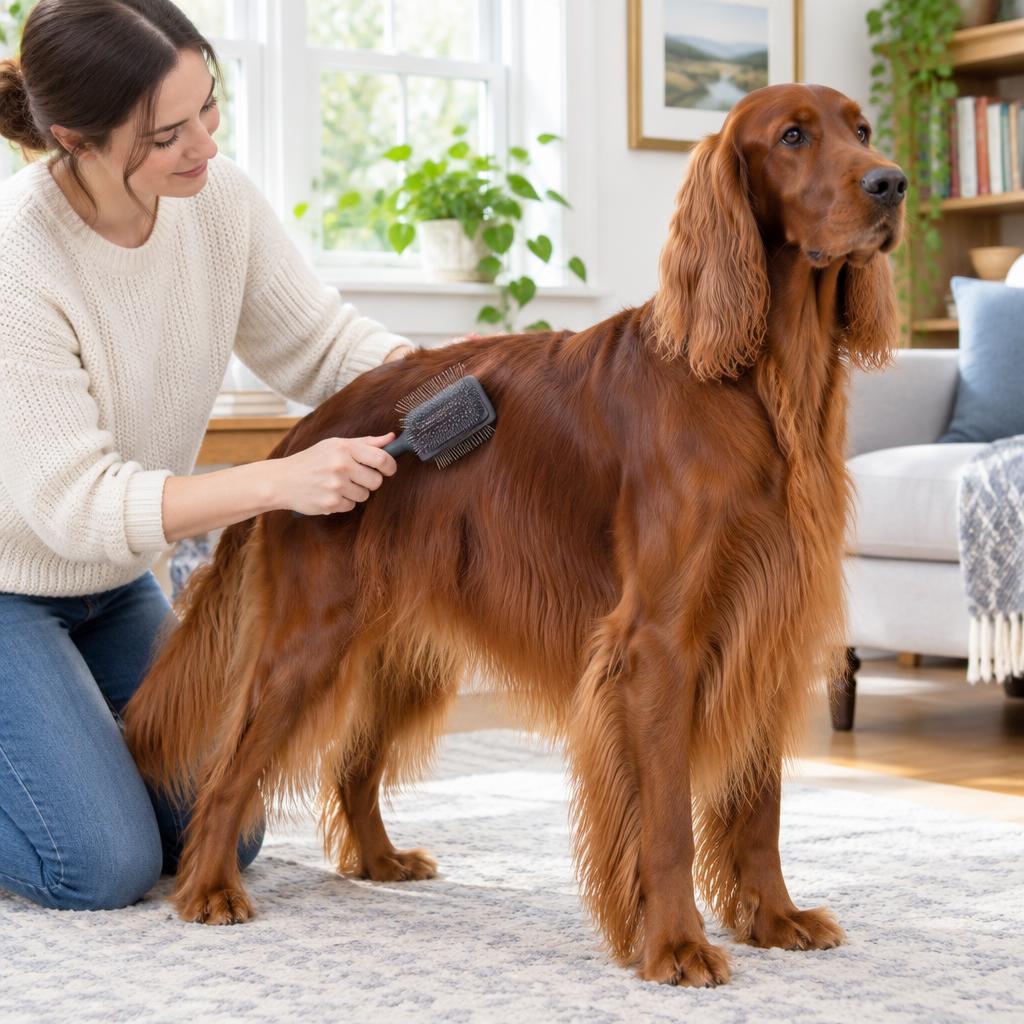
What you actually need
- Pin brush
- Slicker brush
- Metal comb
- Dog nail clippers
- Ear cleaning solution
- Enzymatic dog toothpaste and brush
Puppy to adult
| Age | Male | Female | What is happening |
|---|---|---|---|
| 8 weeks | 3.5 to 4.5 kg | 3 to 4 kg | Fearless and sociable; begin gentle handling and recall foundations now. |
| 3 months | 9 to 12 kg | 8 to 11 kg | Growing fast; keep exercise gentle and free-running rather than forced. |
| 6 months | 17 to 22 kg | 15 to 19 kg | Leggy adolescent phase; coordination and concentration both temporarily missing. |
| 9 months | 21 to 27 kg | 18 to 23 kg | Near adult height; the feathered coat is developing its full glory. |
| 12 months | 24 to 30 kg | 21 to 26 kg | Adult size nearly reached; mentally still very much a puppy. |
| 24 months | 27 to 32 kg | 24 to 29 kg | Fully grown; maturity of mind arrives gradually through the third year. |
Ranges are typical, not targets. Judge condition by ribs and waist, and check with the ideal weight checker.
What to ask a breeder
- What are the parents' hip scores, and have they had current eye examinations?
- Have the parents been DNA tested for progressive retinal atrophy?
- Is there any history of bloat in your lines?
- How are the puppies raised and socialised before they leave?
- What is the temperament of both parents like, and can I meet the mother?
Health tests to ask for
Ask to see results for both parents before you put down a deposit.
- Hip scores for both parents
- DNA test for progressive retinal atrophy in breeding stock
- Current eye examinations for breeding stock
- Learn the signs of bloat and feed two smaller meals rather than one large one
- Keep the dog lean to protect joints through the growing years
Health watch-list
What to ask a breeder about, and what to watch for over a lifetime. This is orientation, not veterinary advice, anything you notice belongs in front of a vet.
Gastric dilatation-volvulus (bloat)
NotableA life-threatening emergency in deep-chested breeds where the stomach twists. Feed two smaller meals, avoid exercise around mealtimes, and learn the signs: swollen abdomen, unproductive retching, restlessness.
Hip dysplasia
CommonMalformed hip joints leading to pain and arthritis. Choose hip-scored parents and keep the dog lean, especially while growing.
Progressive retinal atrophy
UncommonAn inherited eye disease causing gradual blindness. A DNA test exists and responsible breeders use it; affected dogs adapt well but should not be bred from.
Ear infections
Very likelyThe long, heavy ear flaps trap moisture and debris, making infections one of the breed's most common issues. Weekly checks and cleaning prevent most problems.
Hypothyroidism
Common with ageAn underactive thyroid causing weight gain, coat changes and lethargy in middle age. Easily managed with daily medication.
Epilepsy
UncommonSeizures appear in some lines, usually starting in young adulthood. Most affected dogs live well with medication and management.
What it costs to keep one
Realistic running cost
€87 / month
About €1,044 a year, or roughly €14,616 across a 14-year life, before purchase price, neutering and one-off vet events.
Before the puppy arrives. Budget roughly €500 to 1100 for a crate, bed, lead and harness, bowls, puppy classes, first vaccinations and grooming kit sized for this breed. Figures throughout are indicative and vary a good deal between countries.
Interactive · built for this breed
Is a Irish Setter right for your home?
Seven honest questions about your space, time and household, checked against this breed's exercise need, coat, sociability and tolerance for time alone.
Fit with your routine
89%
A strong fit
Your routine suits a Irish Setter well. Meet adult dogs of the line before you commit.
What to sort out first
- Needs more daily exercise than you have pencilled in.
- Coat needs more brushing or trimming than you have allowed.
Compare more breeds in the matchmaker, or plan meals with the portion calculator.
The verdict, by household
Good for active beginners
Friendly and forgiving of mistakes, but the exercise needs and slow maturity demand genuine commitment.
Excellent
Patient, playful and adoring with children; supervise with toddlers simply because of size and bounce.
Excellent
A superb running, hiking and adventure companion that settles happily at home after proper exercise.
Not recommended
A large, high-energy gundog that needs space and serious daily exercise to be manageable indoors.

When to call your vet
- A swollen, tight abdomen, unproductive retching or restlessness: treat as an emergency for bloat
- Limping or stiffness after exercise, especially in young dogs
- Bumping into furniture or reluctance in dim light, which may indicate eye disease
- Head shaking, ear odour or redness inside the ear flap
- Lethargy, weight loss or a coat that loses its shine
Nothing here is a diagnosis. A swollen, hard belly with retching, collapse, breathing difficulty and sudden hind-leg weakness are emergencies: go straight away.
Irish Setter vs the closest alternatives
| Breed | Weight | Energy | Grooming | € / month |
|---|---|---|---|---|
| Irish Setter | 24 to 32 kg | 9/10 | 6/10 | €87 |
| English Cocker Spaniel | 12 to 16 kg | 8/10 | 6/10 | €192 |
| Boykin Spaniel | 11 to 18 kg | 8/10 | 5/10 | €88 |
| Wirehaired Pointing Griffon | 23 to 32 kg | 8/10 | 5/10 | €98 |
Irish Setter questions, answered
How long do Irish Setters live?
Typically twelve to fifteen years, which is good for a large breed. Keeping them lean, protecting joints while they grow and knowing the signs of bloat all support a long, healthy life.
Do Irish Setters shed?
Yes, moderately and year-round. The silky coat drops hair steadily, and the feathering collects burrs and mud outdoors. Brushing two or three times a week keeps both shedding and mats under control.
Are Irish Setters good with children?
Generally excellent. They are patient, playful and affectionate with children of all ages. The main caution is boisterousness: a young, leaping Setter can accidentally knock over a small child, so supervision and manners training matter.
How much exercise does an Irish Setter need?
At least ninety minutes of proper exercise daily, ideally including off-lead running in safe areas. This is a high-energy working gundog, and a quick walk around the block will not touch the sides.
Are Irish Setters easy to train?
They are intelligent and willing but mature slowly and have an attention span that wanders when something interesting appears. Short, fun, consistent sessions work well; recall is usually a lifelong project rather than a finished skill.
Do Irish Setters get on with other dogs?
Usually very well. The breed is typically sociable and easy with other dogs, and their gundog heritage means a softer prey drive than terriers, though birds and squirrels remain fascinating.
Are Irish Setters prone to bloat?
Yes. As a deep-chested breed they carry a real risk of gastric dilatation-volvulus. Feed two smaller meals a day, avoid vigorous exercise around mealtimes, and learn the emergency signs before you ever need them.