
How Much Should I Feed My Dog? Portions by Weight and Age
The right amount is not on the packet. It is on your dog's ribs.
The SniffScroll desk
Published 9 October 2026
Reviewed against WSAVA feeding guidelines
The short version
- Bag feeding guides assume an unneutered active dog and err upward; most pets need 20 to 30 percent less.
- An average neutered adult needs about 25 to 30 kcal per kilo per day; convert to grams using your food's kcal per 100 g.
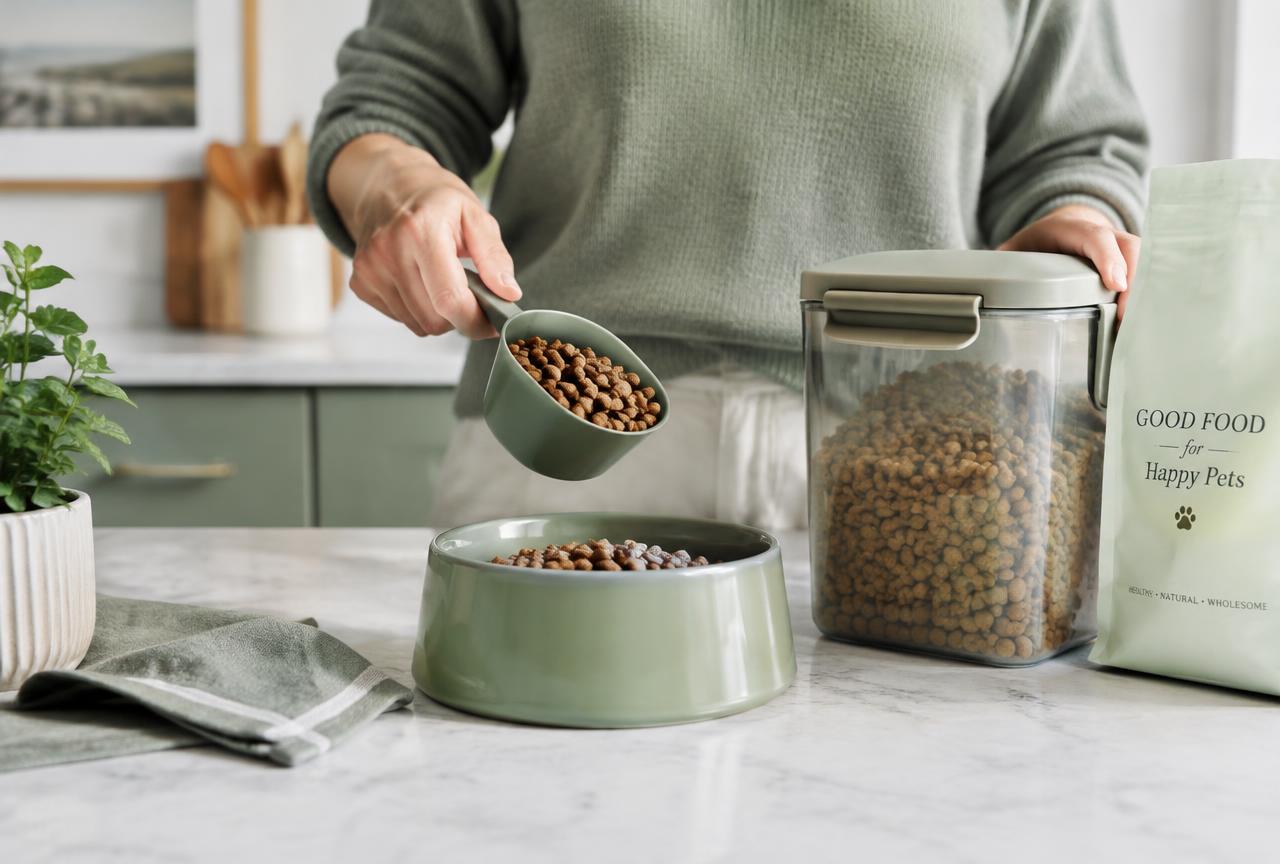
- Weigh food on a scale: cup feeding overfeeds by 10 to 20 percent.
- Puppies need double the calories per kilo across three to four meals; seniors need 10 to 20 percent less than adults.
- The monthly rib, waist and tuck check is the real feeding guide; adjust portions 10 percent at a time.
Every bag of dog food carries a feeding guide, and almost every one of them overestimates. Those tables are written for intact, moderately active dogs, and they err upward because a brand has nothing to lose by you buying food faster. The result is one of the most widespread and least discussed problems in dog ownership: most pet dogs are overfed, and most of their owners do not know it, because the dog looks normal compared to all the other overfed dogs at the park.
Getting the portion right is not complicated, but it does require ignoring the front of the bag and learning three things: how many calories your dog actually needs, how many calories the food actually contains, and what a healthy dog looks and feels like. This guide gives you all three.
How much should I feed my dog? The short answer
A typical neutered adult dog needs roughly 70 times its weight in kilos to the power of 0.75 as a resting baseline, multiplied by 1.4 to 1.8 for normal life. In practice that means about 25 to 30 calories per kilo of body weight per day for an average adult. Convert that to grams using the kcal per 100 g figure on your specific food, split it into two meals, then adjust by 10 percent steps based on monthly body condition checks. Puppies, seniors, very active dogs and overweight dogs all sit outside that average, which the sections below cover.
Why the feeding guide on the bag misleads
Feeding tables have two structural problems. First, they assume an unneutered, reasonably active dog; a neutered, sofa-loving companion can need 30 percent less than the table suggests. Second, they give wide ranges that people read from the top. A table saying "180 to 260 g" for a 15 kg dog is not wrong, exactly, but the difference between the ends of that range is the difference between a lean dog and a fat one.
The calorie approach is more honest. Find the metabolisable energy figure on the bag, usually listed as kcal per 100 g, and work from your dog''s actual need rather than the table''s average dog. The calculator above does the maths for you using the standard WSAVA equations vets use.
Portions by weight: a working table
For a neutered adult dog of healthy weight on a typical dry food of around 360 kcal per 100 g, daily portions land roughly here:
| Dog weight | Daily calories | Approx. dry food per day |
|---|---|---|
| --- | --- | --- |
| 5 kg | 330 to 400 kcal | 90 to 110 g |
| 10 kg | 560 to 670 kcal | 155 to 185 g |
| 15 kg | 760 to 910 kcal | 210 to 250 g |
| 20 kg | 940 to 1,130 kcal | 260 to 315 g |
| 30 kg | 1,270 to 1,530 kcal | 355 to 425 g |
| 40 kg | 1,580 to 1,900 kcal | 440 to 530 g |
Treat these as starting points. Your food''s calorie density, your dog''s activity and your dog''s metabolism will shift the real number, which is why the body condition check at the end of this guide is the actual answer.
Puppies: little and often
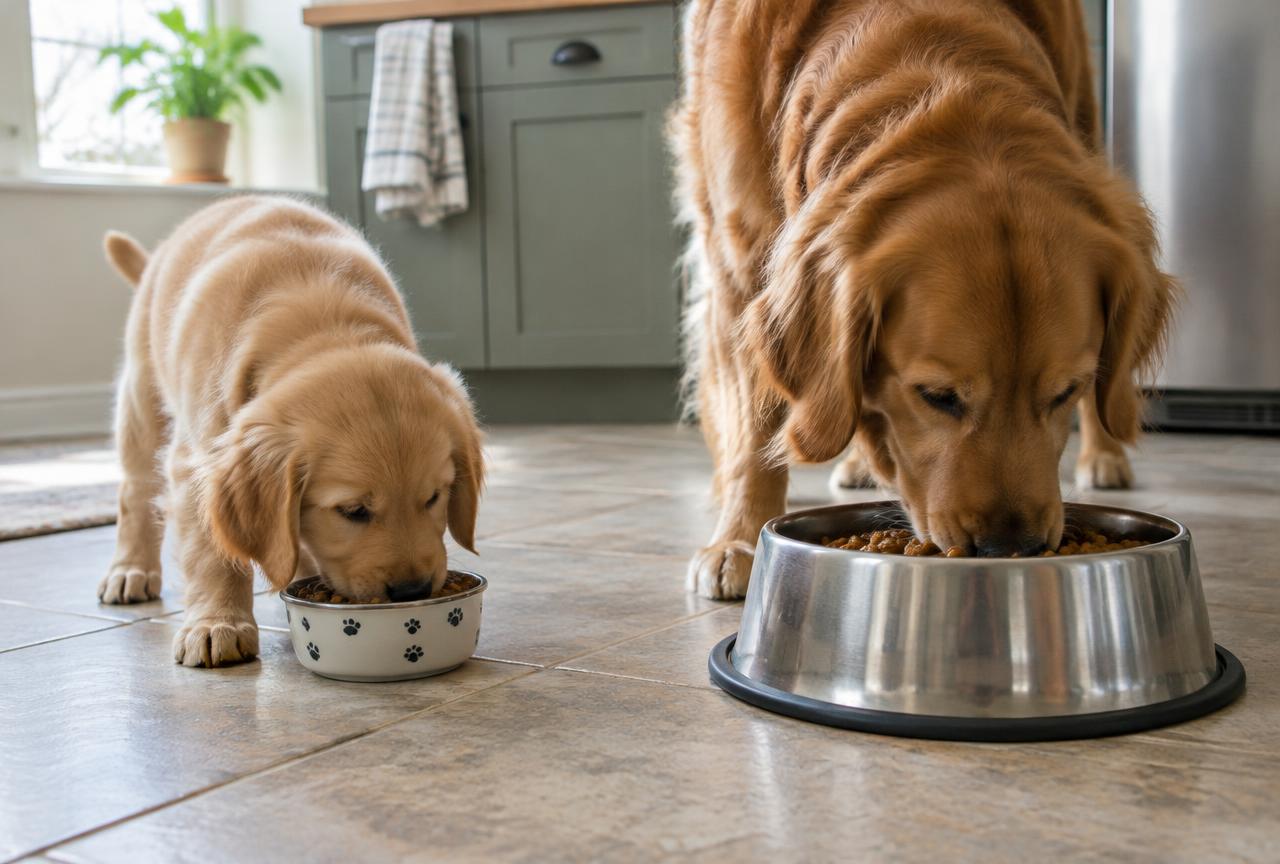
Puppies are not small adults. They need roughly double the calories per kilo of an adult while they grow, fed across more meals, on food formulated for growth. A workable schedule: three to four meals a day up to four months, three meals to six months, then two meals for life. Giant breed puppies are a special case: they need controlled calcium and calories to grow slowly, because fast growth in a Great Dane puppy is a joint problem waiting to happen. Feed a large-breed puppy formula and resist the urge to fatten a puppy; a lean puppy grows into a sounder adult.
Seniors, workers and weight cases
Seniors need fewer calories as activity drops, usually 10 to 20 percent less than their adult portion, but they still need good protein to protect muscle. A senior formula or a modest portion reduction handles most of it; the monthly rib check handles the rest.
Working and very active dogs can need 50 percent more than the table average, and sled dogs several times more. If your dog works, hunts or runs with you most days, feed for the work, and feed after exercise rather than before to protect against bloat in deep-chested breeds.
Overweight dogs should be fed for their target weight, not their current weight, using the resting energy of the ideal weight with no activity multiplier. That sounds technical; your vet can give you the number in one minute, and many will weigh your dog free between appointments.
The check that actually matters: body condition
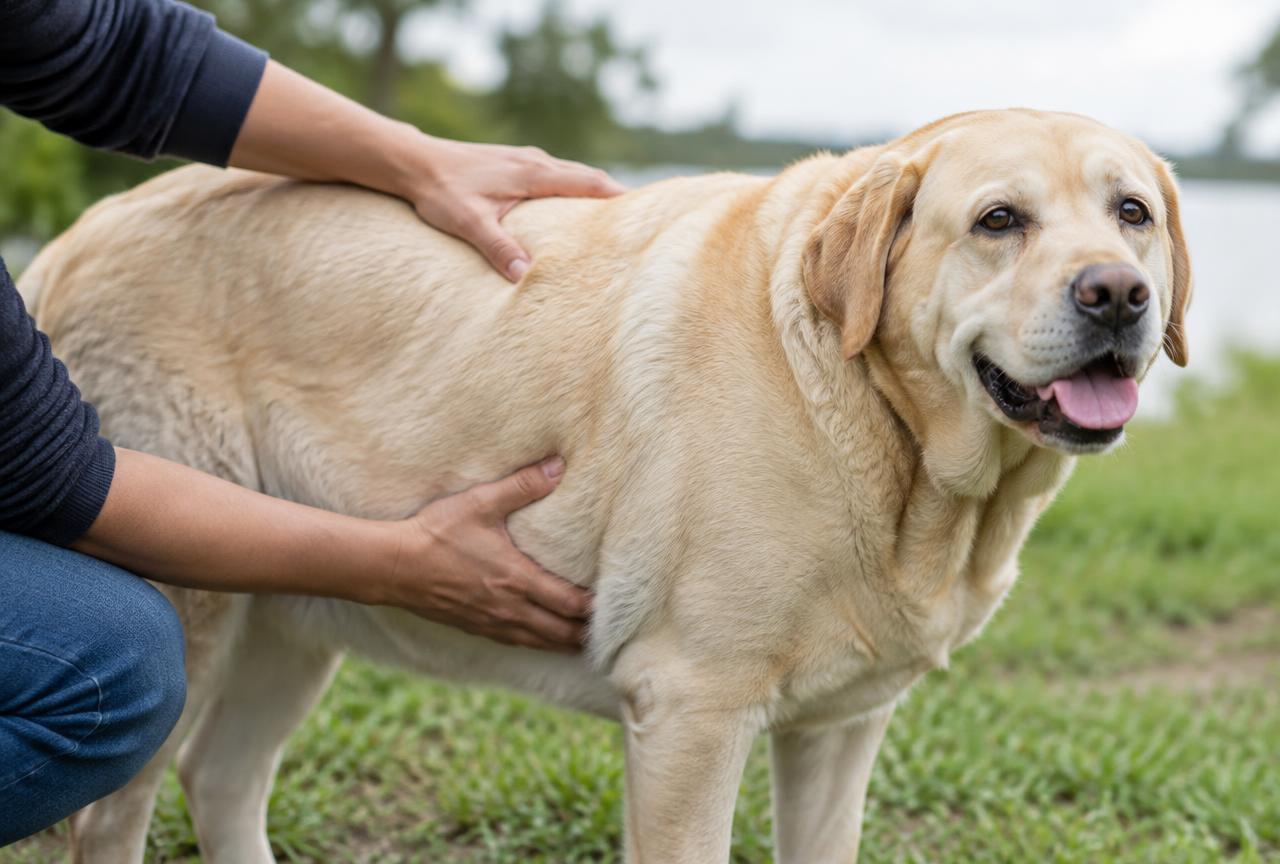
All the maths above is a starting estimate. The truth lives on the dog. Once a month, do the three-part check vets use.
Ribs. Run your hands along the ribcage. You should feel individual ribs easily under a thin layer of fat, like the back of your hand. If you have to press to find them, the dog is carrying too much.
Waist. Look from above. There should be a visible narrowing behind the ribs. A dog that is the same width from shoulders to hips is overweight.
Tuck. Look from the side. The belly should tuck up behind the ribcage. A straight line or a sag means too much.
If the dog fails the check, cut the daily portion by 10 percent and re-check in a month. If the ribs are becoming prominent and the hip bones sharp, add 10 percent. Small steps, monthly reviews. That feedback loop is the entire secret of feeding correctly, and it works with any food at any price.
Meal timing and the practical rules
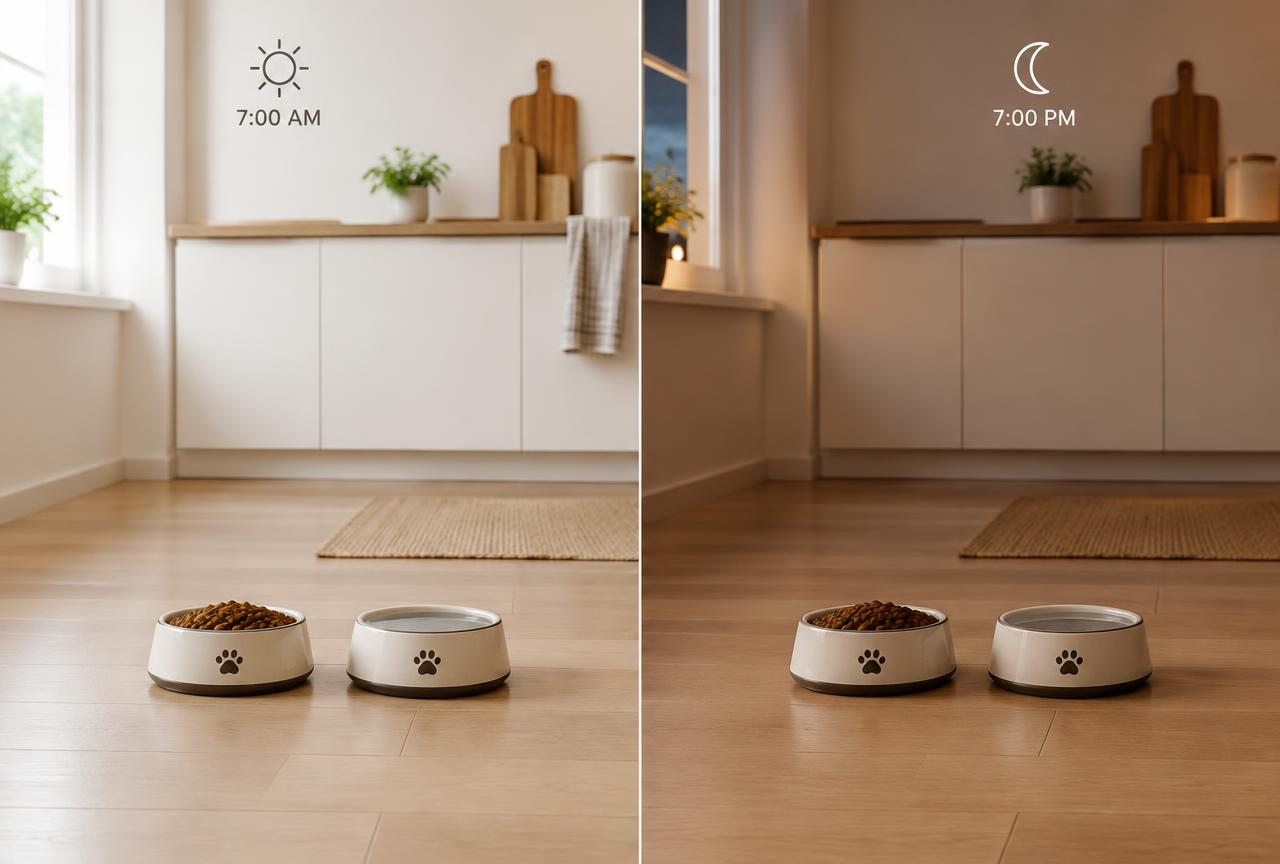
Two meals a day suits almost every adult dog: morning and early evening, roughly twelve hours apart. Fixed times matter because appetite, digestion and toileting all settle into the rhythm, and because a dog fed on a schedule is a dog whose appetite changes you will notice, which is one of the best early illness detectors you have.
A few rules worth printing on the fridge. Weigh food with a scale, not a cup: studies show cup feeding overfeeds by 10 to 20 percent. Count treats in the daily total and keep them under 10 percent of calories. Change foods gradually over a week. Keep fresh water down at all times. And do not exercise a dog hard for an hour either side of a meal, particularly large deep-chested breeds, where the combination raises bloat risk.
Interactive · portion calculator
How much should your dog eat?
Enter weight, life stage and activity for a daily calorie and portion estimate based on standard feeding equations.
About 854 kcal a day, roughly 237 g of typical dry food
Split into 2 meals of about 119 g each. This is a starting point for an ideal-weight dog: adjust up or down by 10 percent based on monthly body condition checks.
Feeding tips
- Weigh the food for a week rather than using a cup: scoops routinely overfeed by 10 to 20 percent.
- Adjust for the food you actually use: check the kcal per 100 g on the bag and scale the 237 g figure accordingly.
- Treats count. Keep them under 10 percent of daily calories and subtract them from the bowl.
- Re-check body condition monthly: you should feel ribs easily under a thin fat cover and see a waist from above.
The bottom line
Feed the dog in front of you, not the dog on the bag. Start from the calorie estimate, weigh the food, split it into two meals, and let the monthly rib check steer. Get that loop running and you will never need to guess again, and your dog will carry a healthy weight for life, which is worth more years than any supplement on the shelf.
Questions people actually ask
How many times a day should I feed my dog?
Twice a day for almost every adult dog, roughly twelve hours apart. Puppies need three to four meals up to six months, then move to two.
Is it OK to feed a dog once a day?
Some healthy adults do fine on one meal, but two smaller meals are kinder on digestion, reduce hunger-driven scavenging and lower bloat risk in large breeds.
How do I know if I am feeding my dog too much?
Do the monthly check: you should feel ribs easily under a thin fat cover, see a waist from above and a belly tuck from the side. If not, cut the portion by 10 percent and re-check in a month.
How much should a puppy eat?
Roughly double the calories per kilo of an adult, split into three to four meals on a puppy formula. Giant breed puppies need a large-breed puppy food to keep growth slow and protect joints.
Do treats count towards daily food?
Yes. Keep treats under 10 percent of daily calories and subtract them from the bowl. A handful of training treats can be a quarter of a small dog's daily needs.
My dog always seems hungry. Should I feed more?
Not necessarily. Many dogs are professional beggars regardless of need. Check body condition first: if ribs, waist and tuck are correct, the dog is getting enough, whatever the performance says.
Sources
Breeds mentioned

Labrador Retriever
Britain's most popular family dog: biddable, food driven and built for an active household.

Golden Retriever
A gentle, biddable gundog famed for its patience with children and its glossy golden coat.
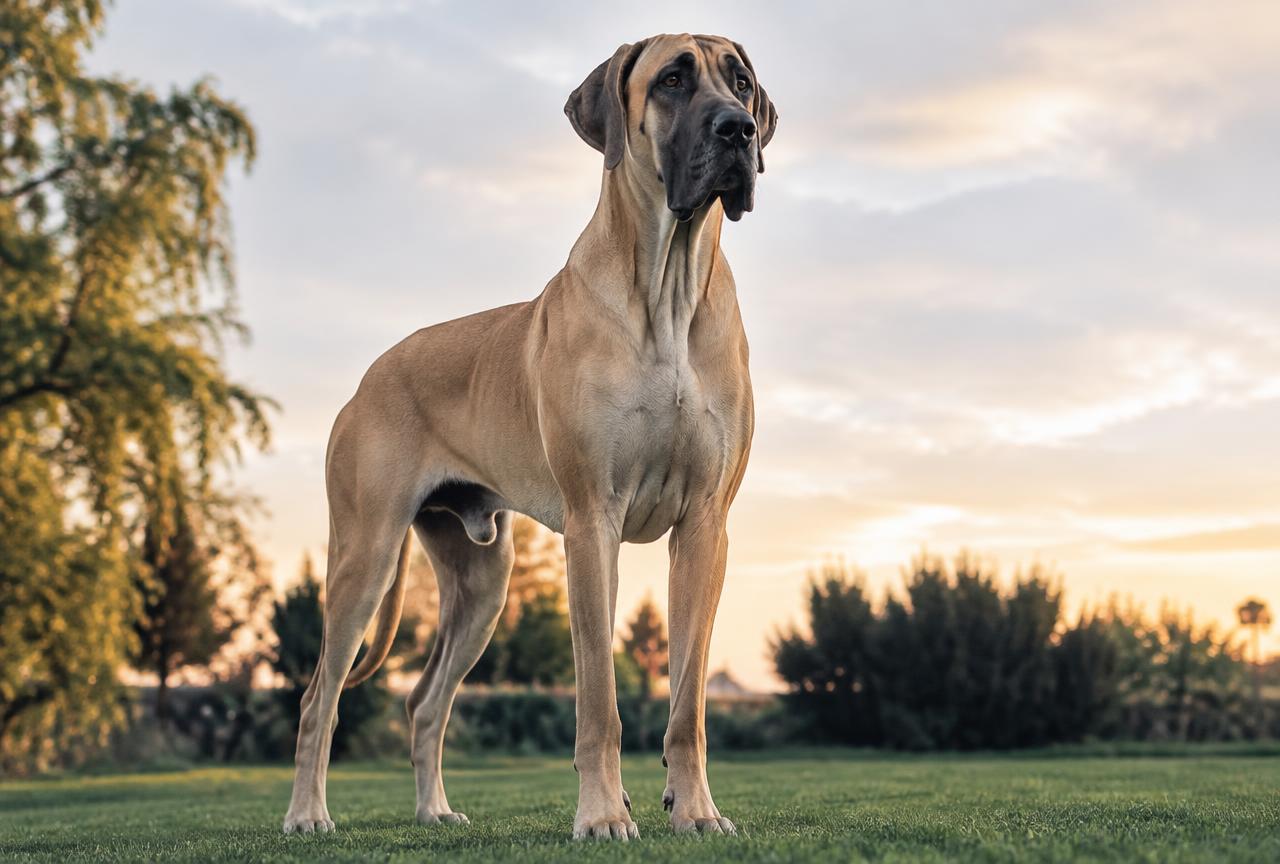
Great Dane
A gentle giant whose enormous size demands patient growth, vigilant bloat awareness and an honest look at lifespan and cost.

Border Collie
The world's most capable herding mind, needing an equally capable owner to match it.
Put it into practice
Read next
Can Dogs Eat Oatmeal? Cooked, Raw and Flavoured
Plain oatmeal cooked in water is safe for dogs in small servings and its soluble fibre can help mild diarrhoea. Avoid flavoured sachets, raw oats and porridge made with milk or sugar.


