
Can Dogs Eat Cherries? Pits, Stems and the Real Risk
The flesh is a safe occasional treat, but the pit, stem and leaf carry a genuine cyanide and blockage risk. Here is how to share cherries safely, and what to do if your dog raided the bowl.
The SniffScroll desk
Published 11 October 2026

Dr Emma Hartley MRCVS
The short version
- Cherry flesh is safe in small amounts once pitted; the pit, stem and leaf carry cyanide compounds.
- Cherry pits are a genuine choking and gut-blockage risk, especially for small dogs.
- Maraschino and tinned-in-syrup cherries are pitted but loaded with sugar: best avoided.
- A serving is two to four pitted, halved cherries for a medium dog, inside the 10% treat allowance.
- Phone the vet if your dog eats pits or stems, and treat vomiting, a swollen belly or breathing changes as an emergency.
Can dogs eat cherries?
Yes, dogs can eat cherry flesh in small amounts, as long as every pit, stem and leaf is removed first. The soft red flesh is not toxic and most dogs enjoy it. The risk sits entirely in the parts we throw away: cherry pits, stems and leaves contain cyanogenic compounds, and the pits themselves are the perfect size to lodge in a small dog's gut.
So this is a fruit where the answer is genuinely "yes, but". A few pitted, halved cherries make a reasonable summer treat. A bowl of whole cherries left on the coffee table is a different story, and a dog that has raided the cherry tree in the garden needs a phone call to the vet.
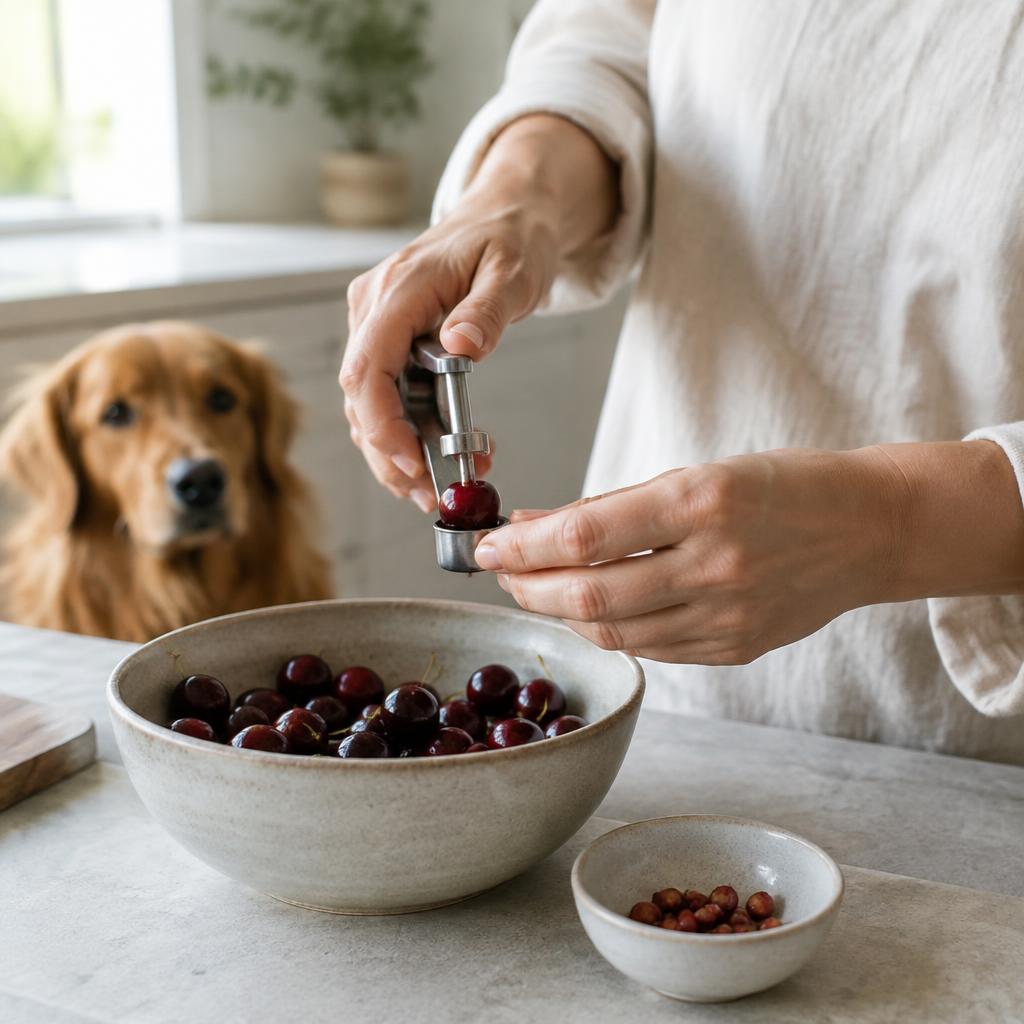
Why the pit is the problem
Cherry pits, stems and leaves contain amygdalin, a compound that releases cyanide when it is chewed and digested. A dog would need to chew and eat a fair number of pits to reach a dangerous cyanide dose, and a swallowed whole pit often passes without releasing much at all. That is the reassuring part.
The less reassuring part is mechanical. A cherry pit is smooth, hard and exactly the wrong size: small enough to swallow, large enough to get stuck. Intestinal blockages from fruit stones are a genuine surgical emergency, and small breeds are most at risk. Add the choking risk of a whole cherry going down in one, and the rule writes itself: pits out, always.
What about maraschino and tinned cherries?
Maraschino and glace cherries have already been pitted, so the cyanide and blockage risk is gone. What replaces it is sugar, and a lot of it. These cherries are soaked in syrup and often dyed, and a handful is enough to trigger diarrhoea in many dogs. One stray maraschino cherry off a cocktail stick is unlikely to cause harm, but they should never be a deliberate treat, and they are off the menu entirely for diabetic or overweight dogs.
Tinned cherries in syrup sit in the same category. Cherries tinned in natural juice, rinsed well, are acceptable in a pinch, but fresh is always the better choice.
How many cherries can a dog eat?
Treats of any kind, fruit included, should make up no more than 10% of a dog's daily calories. Cherries are roughly 8 to 10 calories each, so the maths is simple:
| Dog size | Sensible serving | How often |
|---|---|---|
| --- | --- | --- |
| Toy (under 5 kg) | 1 pitted cherry, halved | Once or twice a week |
| Small (5 to 10 kg) | 2 pitted cherries, halved | Once or twice a week |
| Medium (10 to 25 kg) | 3 to 4 pitted cherries | Once or twice a week |
| Large (25 kg plus) | 4 to 5 pitted cherries | Once or twice a week |
More than this and you are mostly feeding sugar, which shows up as loose stools first and weight gain later.

How to serve cherries safely
- 1Wash the cherries and pull off every stem.
- 2Pit each one with a pitter or a small knife, and check no pit fragments remain.
- 3Halve or quarter the flesh, especially for small dogs.
- 4Serve fresh, or freeze pitted halves for a cooling summer treat.
- 5Put the pits and stems straight into a lidded bin your dog cannot open.
That last step matters more than people expect. The bowl of pits on the side is often more tempting than the fruit itself, and it is where most cherry incidents start.

My dog ate cherry pits: what now?
Stay calm and gather the facts: roughly how many pits, when, and whether they were chewed or swallowed whole. Then phone your vet or a pet poison line and give them those details. One or two swallowed pits in a large dog will usually pass, but your vet may want you to watch for signs of a blockage over the next 48 hours: vomiting, not eating, a painful or swollen belly, straining, or unusual lethargy. Any of those means an urgent visit.
Do not try to make your dog sick at home unless a vet specifically tells you to. And if your dog chewed a quantity of pits, or is showing drooling, bright red gums, breathing changes or wobbliness, treat it as an emergency and go straight in.
Interactive tool
Cherry safety checker
Dog size, the part eaten and roughly how much, in. Clear guidance out.
Your plan
- For a medium dog, a serving is two to four pitted, halved cherries, inside the 10% treat allowance.
- Remove every pit and stem, cut the flesh in half, and serve fresh rather than tinned or syruped.
- Cherries carry sugar, so keep them occasional, especially for overweight or diabetic dogs.
- Introduce slowly and watch for loose stools the first time.
Pitted flesh is fine in small amounts
The flesh is a safe occasional treat. The pit, stem and leaf are the problem parts.
Are cherries actually good for dogs?
In the small amounts a dog should eat, cherries are a pleasant extra rather than a health food, but they do bring a few genuine benefits. The flesh contains vitamin C, fibre and a decent spread of antioxidants, including the anthocyanins that give the fruit its deep red colour. Cherries also contain a little natural melatonin, which is part of why they are studied in human sleep research, though the amount in two or three cherries is far too small to sedate a dog.
The honest framing is this: cherries are a low-calorie treat that happens to carry some useful nutrients, not a supplement. Your dog's complete food already covers their nutritional needs, so think of cherries the way you would think of a good biscuit for yourself: enjoyable, harmless in moderation, and not a reason to skip dinner.
Cherry products: a quick comparison
| Cherry product | Safe for dogs? | Why |
|---|---|---|
| --- | --- | --- |
| Fresh, pitted, halved | Yes, in small servings | The safest form |
| Fresh, whole with pit | No | Choking, blockage and cyanide risk |
| Frozen, pitted | Yes | A good cooling summer treat |
| Maraschino or glace | Best avoided | Pitted but soaked in sugar syrup |
| Tinned in syrup | Best avoided | Heavy sugar load |
| Tinned in juice, rinsed | Acceptable rarely | Still sweeter than fresh |
| Dried | Best avoided | Concentrated sugar, possible sweeteners |
| Cherry jam, pie, yoghurt | Best avoided | Sugar, dairy, possible xylitol |
Keeping cherry season incident-free
Most cherry problems are storage problems. Dogs that counter-surf, and there is a Labrador or a Beagle in most of those stories, do not distinguish between the fruit and the pit. Keep bowls of cherries in the fridge or well back from counter edges, pit them over a lidded bin rather than an open bowl, and clear up dropped fruit straight away. In the garden, rake up windfall cherries before walks rather than after, and teach a solid "leave it" for the fruit that escapes you. A little prevention is worth a great deal of worry.
When to see a vet
Phone the vet the same day if your dog has eaten cherry pits, stems or leaves in any quantity, especially a small dog. Go immediately if you see vomiting, a swollen or painful belly, drooling, bright red gums, laboured breathing, wobbliness or collapse. Trust your instincts: you know what normal looks like for your dog.

A note for multi-dog households
If you share cherries with one dog, assume the others will want theirs too, and portion for each dog separately rather than letting them graze from one bowl. The fastest eater will otherwise take the lot, and resource guarding over a high-value treat can start a scuffle. Feed each dog their own small serving, a little apart, and pick up anything uneaten before it becomes a game of keep-away with the pits still in.
The bottom line
Cherries are a fruit of two halves. The flesh is a perfectly good occasional treat: low in calories, a little fibre, some vitamin C, and most dogs like the taste. The pit, stem and leaf are the hazard, carrying cyanide compounds and a real blockage risk. Pit them, halve them, keep portions small, and bin the leftovers securely. Do that, and your dog can share a little of your summer bowl quite safely.
If your dog enjoys fruit, it is worth reading our guides to can dogs eat fruit and can dogs eat apples, and the foods dogs must never eat list for the other end of the scale. Breeds that live for food, like the Labrador and the Beagle, are the most likely to counter-surf a bowl of cherries, so storage matters as much as preparation. Our portion calculator can help you keep treats inside the daily allowance.
Frequently asked questions
Can dogs eat cherry yoghurt or cherry ice cream?
Small licks are unlikely to harm a healthy dog, but these are sugary dairy products and many dogs are lactose sensitive. Check the label for xylitol, which is toxic, and otherwise treat them as a rare lick rather than a serving.
Are cherry trees poisonous to dogs?
The wilted leaves, stems and pits of cherry trees contain cyanogenic compounds, and fallen fermenting fruit adds a stomach-upset risk. If your dog grazes under a cherry tree, rake up fallen fruit and call the vet if you see drooling, red gums or breathing changes.
Can puppies eat cherries?
A small piece of pitted flesh is safe for a puppy, but their stomachs are sensitive and the choking risk is higher. Wait until they are comfortably on solid food, offer a tiny amount, and watch for loose stools.
What are the signs of cyanide poisoning in dogs?
Drooling, bright red gums, rapid or laboured breathing, dilated pupils, wobbliness and collapse. It is rare from cherries alone, because a dog must chew many pits, but it is an emergency if you see these signs.
Can dogs eat dried cherries?
Dried cherries are pitted but very concentrated in sugar, and some contain added sweeteners. They are best avoided; fresh pitted cherries are the better choice.
My dog ate one whole cherry. Should I worry?
One whole cherry, pit included, will almost always pass through a medium or large dog without trouble. Watch for vomiting, a painful belly or straining over the next 48 hours, and phone the vet if any appear. For toy breeds, a quick vet call for advice is sensible.
Sources
- American Kennel Club, "Can Dogs Eat Cherries?", akc.org
- VCA Animal Hospitals, "Cyanide Poisoning in Dogs", vcahospitals.com
- Pet Poison Helpline, "Cherry Toxicity in Dogs", petpoisonhelpline.com
- PDSA, "Safe fruits for dogs", pdsa.org.uk
- Merck Veterinary Manual, "Foreign Bodies of the Digestive System", merckvetmanual.com
Questions people actually ask
Can dogs eat cherry yoghurt or cherry ice cream?
Small licks are unlikely to harm a healthy dog, but these are sugary dairy products and many dogs are lactose sensitive. Check the label for xylitol, which is toxic, and otherwise treat them as a rare lick rather than a serving.
Are cherry trees poisonous to dogs?
The wilted leaves, stems and pits of cherry trees contain cyanogenic compounds, and fallen fermenting fruit adds a stomach-upset risk. Rake up fallen fruit and call the vet if you see drooling, red gums or breathing changes.
Can puppies eat cherries?
A small piece of pitted flesh is safe for a puppy, but their stomachs are sensitive and the choking risk is higher. Offer a tiny amount once they are on solid food and watch for loose stools.
What are the signs of cyanide poisoning in dogs?
Drooling, bright red gums, rapid or laboured breathing, dilated pupils, wobbliness and collapse. It is rare from cherries alone, but it is an emergency if you see these signs.
Can dogs eat dried cherries?
Dried cherries are pitted but very concentrated in sugar, and some contain added sweeteners. They are best avoided; fresh pitted cherries are the better choice.
My dog ate one whole cherry. Should I worry?
One whole cherry will almost always pass through a medium or large dog without trouble. Watch for vomiting, a painful belly or straining over 48 hours, and phone the vet for advice if your dog is a toy breed.
Sources
Breeds mentioned


Put it into practice
Read next
Can Dogs Eat Oatmeal? Cooked, Raw and Flavoured
Plain oatmeal cooked in water is safe for dogs in small servings and its soluble fibre can help mild diarrhoea. Avoid flavoured sachets, raw oats and porridge made with milk or sugar.


